Industrial assets operate in demanding environments where degradation, damage, and unexpected conditions can occur over time. When issues arise, operators need clear, defensible answers — not uncertainty. Slate Consulting provides comprehensive Fitness‑for‑Service (FFS) assessments to help clients make informed decisions about the continued safe operation of pressure equipment, piping, and structural components.
Our assessments follow internationally recognised methodologies and deliver practical, regulator‑ready guidance that balances safety, reliability, and commercial realities.
FITNESS FOR SERVICE
Standards‑Aligned Engineering Assessment
Slate Consulting performs FFS evaluations in accordance with API 579‑1/ASME FFS‑1, ASME Section VIII, and relevant Australian Standards. Our engineers apply a structured, code‑compliant approach to determine whether equipment can continue operating safely, requires repair, or needs mitigation measures.
Our capabilities include:
Assessment of in‑service damage mechanisms, including corrosion, pitting, erosion, cracking, deformation, and weld defects
Level 1, 2, and 3 evaluations depending on complexity and risk
Remaining life calculations and inspection interval recommendations
Assessment of out‑of‑roundness, local thinning, dents, and mechanical damage
Evaluation of operating conditions, including pressure, temperature, cyclic loading, and transients
Regulator‑ready documentation for statutory submissions and safety case updates
Level 3 Fitness‑for‑Service Assessment Using Advanced FEA
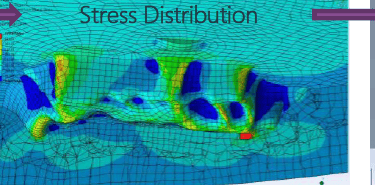
For complex damage scenarios or geometries that fall outside the limits of simplified assessment methods, Slate Consulting performs Level 3 Fitness‑for‑Service evaluations using advanced Finite Element Analysis (FEA). These analyses provide the highest level of technical rigour available under API 579‑1/ASME FFS‑1 and are often required when equipment integrity must be demonstrated with maximum confidence.
Our Level 3 FEA‑based assessments include:
Detailed stress–strain modelling using elastic‑plastic material behaviour
Limit load and collapse analysis to establish remaining strength and safety margins
Fracture mechanics modelling for crack‑like flaws, including J‑integral and CTOD evaluations
Thermal and transient simulations to assess temperature‑driven stresses and thermal shock
Assessment of complex geometries where hand calculations or Level 1/2 methods are not applicable
By integrating high‑fidelity FEA with code‑compliant FFS methodologies, Slate Consulting provides clear, defensible conclusions on continued operation, repair requirements, or de‑rating strategies. This approach is particularly valuable for ageing assets, unique equipment designs, and situations where regulatory authorities require the highest standard of engineering justification.